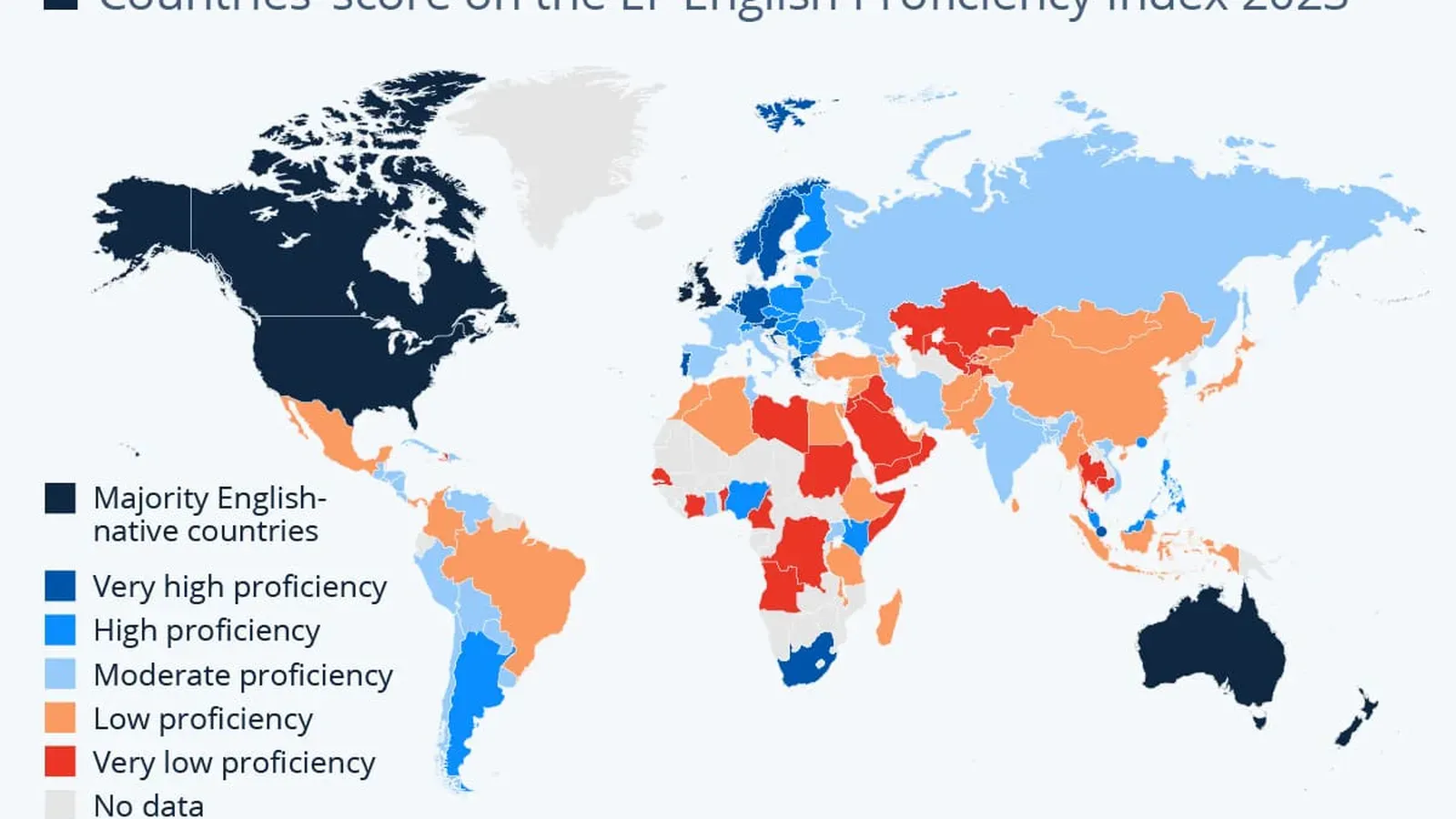



Imagine planning a journey: without a map you can wander for hours, with a route you reach your destination quickly. English works the same way. To move forward with confidence, you need to know two things: where you are now and what the next stop is.
That is what the CEFR scale is for. Below: what each level from A1 to C2 means, how many hours and words each stage takes, how IH Kyiv splits the way into smaller steps, and how to find out your level.
What is CEFR
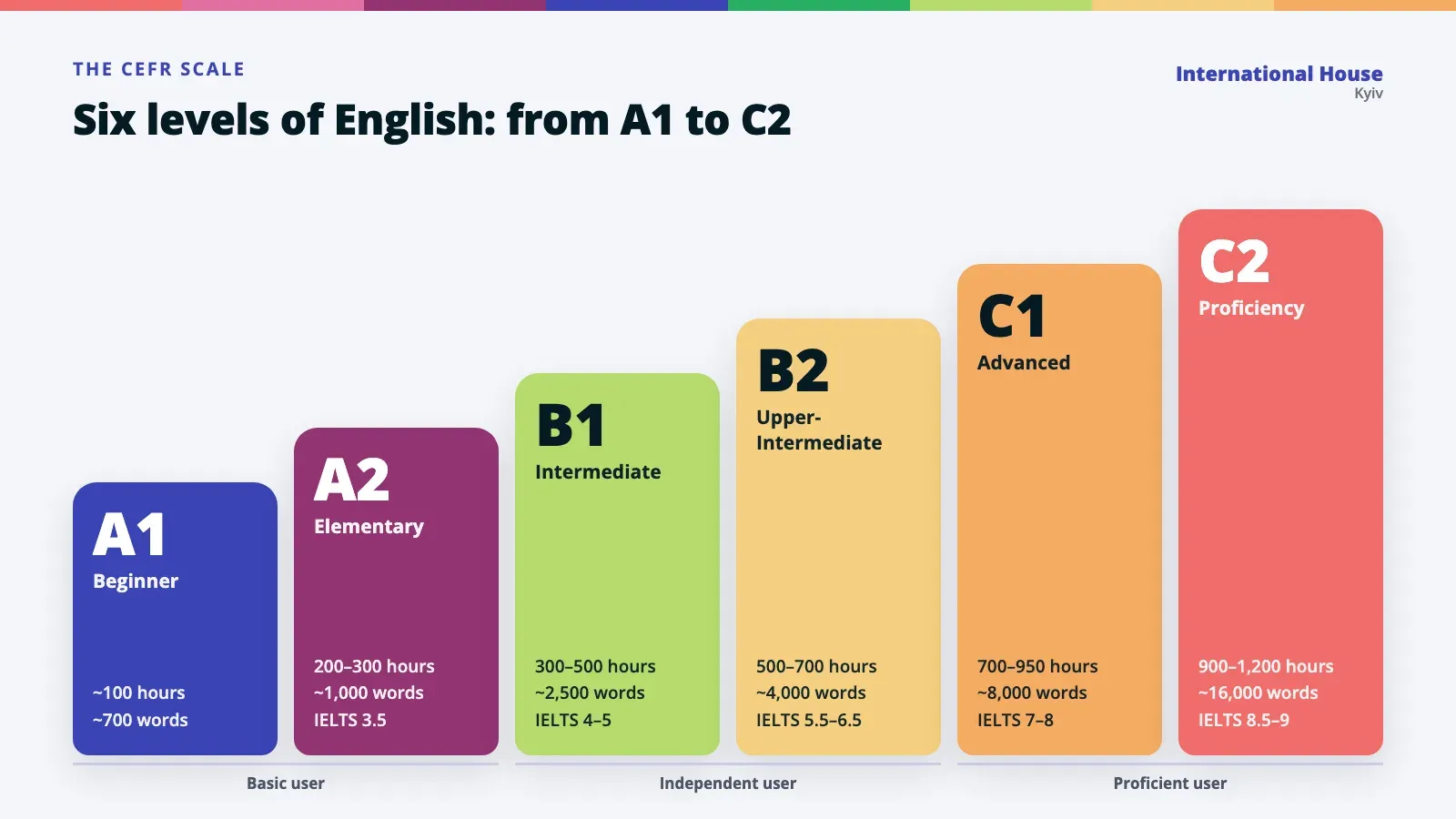
CEFR (Common European Framework of Reference for Languages) is the European scale that divides language learning into six levels: A1, A2, B1, B2, C1, C2. Language schools, universities, employers and international exams all use it.
Knowing your CEFR level, you can:
- choose a course that fits you: basic programmes for beginners, advanced ones for experienced learners;
- pick materials that match your level: simple stories at A2, analytical articles at B2;
- prepare for an exam — IELTS, TOEFL, Cambridge or LanguageCert: each level clearly defines the skills you need to show.
Where the scale came from
By the 1970s it was clear that every country understood “beginner”, “intermediate” or “advanced” in its own way. Separate national grading systems made it hard for schools and universities in different countries to recognise each other’s qualifications.
From 1989 to 1996 the Council of Europe ran the project “Language Learning for European Citizenship”. The starting point for CEFR was a symposium in Rüschlikon, Switzerland, in November 1991. In 2001 the “Common European Framework of Reference for Languages: Learning, Teaching, Assessment” was officially published, and the same year the Council of the EU recommended using it to build national assessment systems.
English levels from A1 to C2
A1 — Beginner
Basic User
- Study time: about 100 hours
- Vocabulary: about 700 words
After this level, a person can:
- Introduce themselves and talk about their family, job, and where they live.
- Ask and answer simple questions.
- Understand familiar words and short phrases when the other person speaks slowly and clearly.
- Order simple food, ask for prices, or express basic needs.
- Write a short message or fill in a form.
Example: A person can say where they are from, where they live, and what they do, but still needs help in most unfamiliar situations.
What to do: apps such as Duolingo, free EngVid lessons, YouTube channels that explain the basics simply — Easy English, for example.
A2 — Elementary
Basic User
- Study time: 200–300 hours
- Vocabulary: about 1,000 words
- IELTS: 3.5
After this level, a person can:
- Communicate on familiar everyday topics: shopping, food, family, work, and free time.
- Understand simple announcements, messages, and instructions.
- Ask for directions, arrange a meeting, and handle simple everyday situations.
- Describe their background, habits, studies, and plans using simple sentences.
- Write a short letter, thank-you note, or message.
Example: A person can maintain a short conversation about daily life, but finds it difficult to sustain a longer conversation without support from the other speaker.
What to do: short podcasts, simple books, the YouTube channel Learn English With TV Series for real dialogues. Try online speaking clubs — many are free.
B1 — Intermediate
Independent User
- Study time: 300–500 hours
- Vocabulary: about 2,500 words
- IELTS: 4–5
After this level, a person can:
- Handle most typical situations likely to arise whilst travelling.
- Maintain a conversation on familiar topics: work, studies, hobbies, events, and current affairs.
- Understand the main points of clear speech or broadcasts on familiar topics.
- Tell stories, describe experiences, dreams, and plans.
- Express personal opinions using simple arguments.
- Write connected text on familiar topics.
Example: A person can now travel and communicate independently, although complex discussions, fast speech, and unfamiliar vocabulary may still cause difficulties.
What to do: a good moment to take a level test. The result will show whether you are ready for harder topics — technical articles, IT blogs, recipes by foreign chefs.
B2 — Upper-Intermediate
Independent User
- Study time: 500–700 hours
- Vocabulary: about 4,000 words
- IELTS: 5.5–6.5
After this level, a person can:
- Interact relatively fluently with native speakers without strain for either party.
- Understand the main ideas of complex texts, lectures, and discussions, including abstract topics.
- Present and defend their point of view with arguments, comparing different perspectives.
- Participate in work meetings, discussions, and presentations on familiar topics.
- Write detailed texts, essays, and reports supported by arguments and examples.
- Watch films and television programmes in standard English, following the main content.
Example: A person can work in an international environment, take part in meetings, and explain more complex ideas, though they may occasionally lack precision or specialised vocabulary.
What to do: English becomes a working tool — webinars on marketing, analytics and IT on Coursera and Udemy, talking to clients abroad without an interpreter.

C1 — Advanced
Proficient User
- Study time: 700–950 hours
- Vocabulary: about 8,000 words
- IELTS: 7–8
After this level, a person can:
- Communicate fluently and spontaneously in social, academic, and professional environments.
- Understand long, complex texts, implicit meanings, and indirect hints.
- Discuss abstract and complex matters, formulating arguments with precision.
- Adapt their style of speech flexibly depending on the situation and listener.
- Deliver presentations on complex topics and answer questions from the audience.
- Write well-structured texts, analytical reports, and reasoned essays.
Example: A person can study or work effectively in a foreign language, take part in complex discussions, and convey subtle nuances of their thoughts.
What to do: Stanford and Oxford lectures, professional articles in academic journals. At this level you truly become part of the international professional world.
C2 — Proficiency
Proficient User
- Study time: 900–1,200 hours
- Vocabulary: about 16,000 words
- IELTS: 8.5–9
After this level, a person can:
- Understand virtually everything heard or read with ease.
- Summarise information from different sources and synthesise it coherently.
- Express themselves spontaneously, very fluently, and precisely, even in complex situations.
- Understand fine shades of meaning, irony, idioms, and stylistic nuances.
- Use the language flexibly in academic, professional, and creative contexts.
- Produce complex texts, tailoring style, structure, and phrasing to suit the purpose.
Example: A person can work confidently with complex texts, conduct professional discussions, and convey subtle distinctions in meaning. C2 does not necessarily mean speaking like a native speaker.
What to do: academic papers and texts, interviews with top companies without language barriers. The language becomes part of who you are.
In short: the main result of each level
- A1 — I can say the essentials
- A2 — I can get by in simple everyday situations
- B1 — I can communicate independently in familiar situations
- B2 — I can fluently discuss many topics and support my opinions
- C1 — I can use the language effectively for demanding professional and academic tasks
- C2 — I can use the language precisely, flexibly, and effortlessly in a wide variety of situations
In-between levels at IH Kyiv
There is a lot of work between the big steps A1 → A2 → B1, so IH Kyiv uses in-between levels: Pre-A1, B1+, B2+ and C1+. They let us place you in the right group more precisely and help you move smoothly, at your pace and towards your goal.
- Flexibility. More time to consolidate before harder topics — without stress.
- Motivation. Interim goals are closer: you reach results step by step, and that builds confidence.
- Exam preparation. Clear skills for each stage help you prepare purposefully for IELTS, TOEFL, Cambridge or LanguageCert.
- A personal approach. Some need more time for grammar, others for speaking or writing.
How to find out your level
The easiest way is to take the free assessment at IH Kyiv. It has two parts: an online grammar and vocabulary test at a time that suits you, and a conversation with a teacher that shows how you speak, understand what you hear and use the language in real situations.
The result is more than a letter. If the test shows B1, for example, the teacher will suggest what to work on — vocabulary, more complex grammar or pronunciation — and which courses, books and apps suit you. That way you do not waste time on material that does not match your level.

Free resources for practice
- Forvo — the largest database of words pronounced by native speakers: type a word and hear it in different accents.
- YouGlish — search for words and phrases in real videos: hear them in context and repeat after native speakers.
- Speechling — pronunciation practice: you record yourself, native speakers check it and give advice.
- BBC Sounds — podcasts with clear pronunciation for listening and vocabulary.
- LyricsTraining — English through song lyrics: listen, sing, train your ear.
- ESL-bits and Breaking News English — graded texts and audio for reading and listening.
What to do next
English levels are markers of your growth: from simple dialogues to professional communication and a deep grasp of complex ideas. Once you were afraid to write to an English-speaking client — later it becomes routine.
Start with your point on the map: take the free level test, then choose an English course for adults that fits your goal.